Document Overview
This white paper focuses on flexible OLED (Soft OLED) screens in the iPhone third-party repair sector. It systematically explains their technical principles, process grades, mainstream brand parameters, performance differences and selection criteria, covering only commercially available third-party flexible OLED accessories (excluding original factory screens, hard OLED and LCD screens). It serves as a standardized technical reference for repair service providers, parts purchasers and end users.
1 Category Definition & Market Positioning
1.1 Technical Definition
Flexible OLED (Soft OLED) is a high-end display accessory in the third-party repair market. It adopts the same polyimide (PI) flexible substrate as original iPhone screens, replacing traditional glass substrates, and achieves bendability through thin film encapsulation (TFE) technology. Among all third-party screen solutions, it delivers the display performance and structural fit closest to original factory screens.
1.2 Market Positioning
- Quality Tier: Top tier of third-party screens, with better display performance, touch response and assembly fit than hard OLED and LCD screens
- Cost Positioning: Priced at 40%-60% of official Apple original screens, saving 30%-50% repair cost compared to original parts
- Application Scenarios: Mainstream option for mid-to-high-end iPhone repairs, compatible with all OLED iPhone models from iPhone X and later
2 Core Technology & Structure
2.1 Substrate Technology: Polyimide Flexible Substrate
- Core Material: Uses high-performance polyimide (PI) film as the array substrate, replacing the glass substrate of hard OLED, with bendable and impact-resistant properties
- Performance Advantages: The panel deforms slightly to absorb impact when dropped, improving shatter resistance by 20%-30% compared to hard OLED; 0.2-0.3mm thinner overall, with thickness tolerance within ±0.05mm vs. original screens, ensuring better assembly fit
- Manufacturing Challenge: Requires laser lift-off (LLO) process to separate the PI film from the carrier glass, with higher technical threshold than glass-based OLED
2.2 Encapsulation Technology: Thin Film Encapsulation (TFE)
Unlike glass-encapsulated OLED, flexible OLED uses alternating inorganic-organic multilayer thin film encapsulation:
- Inorganic layers block moisture and oxygen to extend the lifespan of OLED emitting materials
- Organic layers buffer stress and smooth the surface to support flexible bending
- It is the core technology enabling flexible panels and the key identifier distinguishing flexible from hard OLED
2.3 Assembly Technology: FOG (FPC on Glass)
FOG is the mainstream assembly process for third-party flexible screens, which bonds the flexible printed circuit (FPC) to the edge of the display panel for signal transmission:
- Premium FOG process achieves narrow bottom bezel consistent with original design, with bezel width difference ≤0.2mm
- Supports original driver IC transfer (IC migration) to enable True Tone, auto-brightness and system compatibility without pop-up errors
- Process quality directly determines bezel width, system compatibility and long-term stability, serving as a key grade indicator
2.4 Driver Packaging: COF vs COP
Third-party flexible OLED uses two driver chip packaging levels:
- COF (Chip on Film): Driver chip is bonded to the flexible FPC. It is the mainstream solution for mid-range flexible screens, with mature technology and controllable cost
- COP (Chip on Plastic): Driver chip is directly packaged on the PI flexible substrate, further narrowing the bottom bezel. It is the process benchmark for high-end third-party flexible screens, closest to original factory standards
3 Main Product Grades in the Market
Third-party flexible OLED is divided into three grades based on panel source and assembly quality:
3.1 Original Pulled & Refurbished Flexible OLED
- Panel Source: Original faulty screens pulled from devices, re-encapsulated with replacement cover glass, frame and flex cable
- Performance: Original OLED display core delivers color accuracy, brightness and touch response fully matching original factory standards
- Limitations: Unstable supply; mostly used parts with varying degrees of panel aging; quality highly depends on refurbishment process
3.2 FOG Flexible OLED (Original Core Assembly)
- Panel Source: Uses decommissioned original or equivalent-spec OLED display cores, assembled with third-party cover glass, frame and flex cable
- Performance: Display effect close to original, with over 95% functional completeness, supporting core features like True Tone and auto-brightness
- Market Positioning: Mainstream solution for mid-to-high-end repairs, with outstanding cost-performance, and the core volume product for repair shops
3.3 Domestic Full-Flexible OLED (Branded Third-Party Screens)
- Panel Source: Fully manufactured by domestic panel makers, from emitting layers to complete module assembly
- Performance: Complete brand portfolio covering 60Hz standard and 120Hz high-refresh versions, with improving iOS feature compatibility
- Market Positioning: Dominant supply in the current third-party repair market, with wide quality variation across brands, covering entry to high-end price segments
4 Technical Parameter Comparison of Mainstream Brands
Core parameters and features of mainstream flexible OLED brands in China’s repair market:
表格
| Brand | Process Grade | Typical Peak Brightness | Dimming Method | Refresh Rate Support | Key Features | Compatible iPhone Models |
|---|---|---|---|---|---|---|
| H* | High-end COP Flexible | 1000-1200 nits | High-frequency PWM dimming | 60Hz / 120Hz LTPO | Closest to original display quality; no vertical stripes at low brightness; vivid color and excellent power efficiency | iPhone 12-17 full series Pro/Pro Max |
| R* | Quasi-COP/COF Flexible | 800-950 nits | DC-like dimming | 60Hz / 120Hz | Eye-friendly dimming; warm color tone; high cost-performance; slight graininess at low brightness on some models | iPhone 12-17 standard/Pro series |
| D* | High-end COP / Mainstream COF | COP: 950-1100 nitsCOF: 800-900 nits | PWM dimming | 60Hz / 120Hz LTPO | Dual product line; COP version matches first-tier bezel control and display quality; COF version is affordable with full high-refresh model coverage; average color accuracy | iPhone 12-15 full series standard/Pro/Pro Max |
| J* | Entry-level COF Flexible | 700-850 nits | PWM dimming | 60Hz mainly | Basic display performance; low cost; slightly wider bezel; average color uniformity | Entry-level repair for iPhone 12/13 standard models |
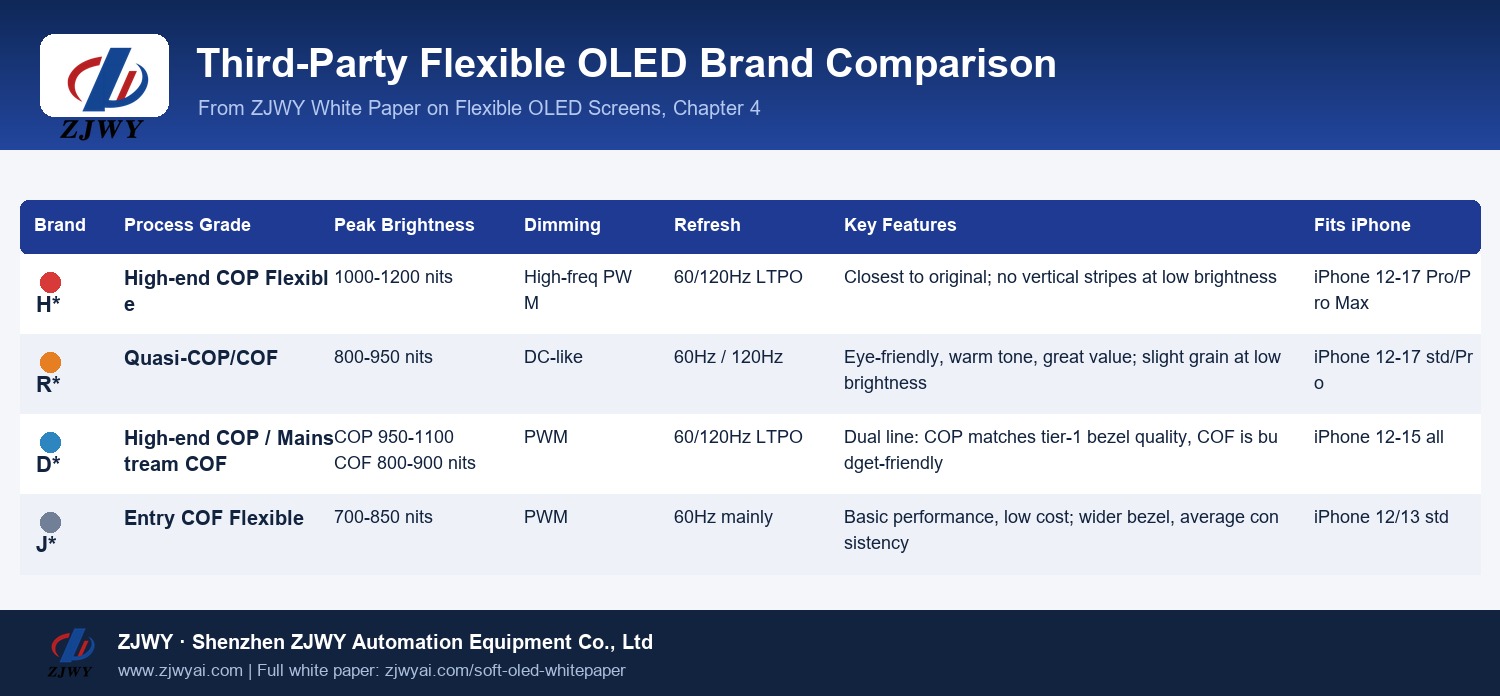
Note: The above are industry nominal values. Minor parameter differences exist across batches and compatible models.
5 Quality Identification Methods
5.1 Core Differences Between Flexible and Hard OLED
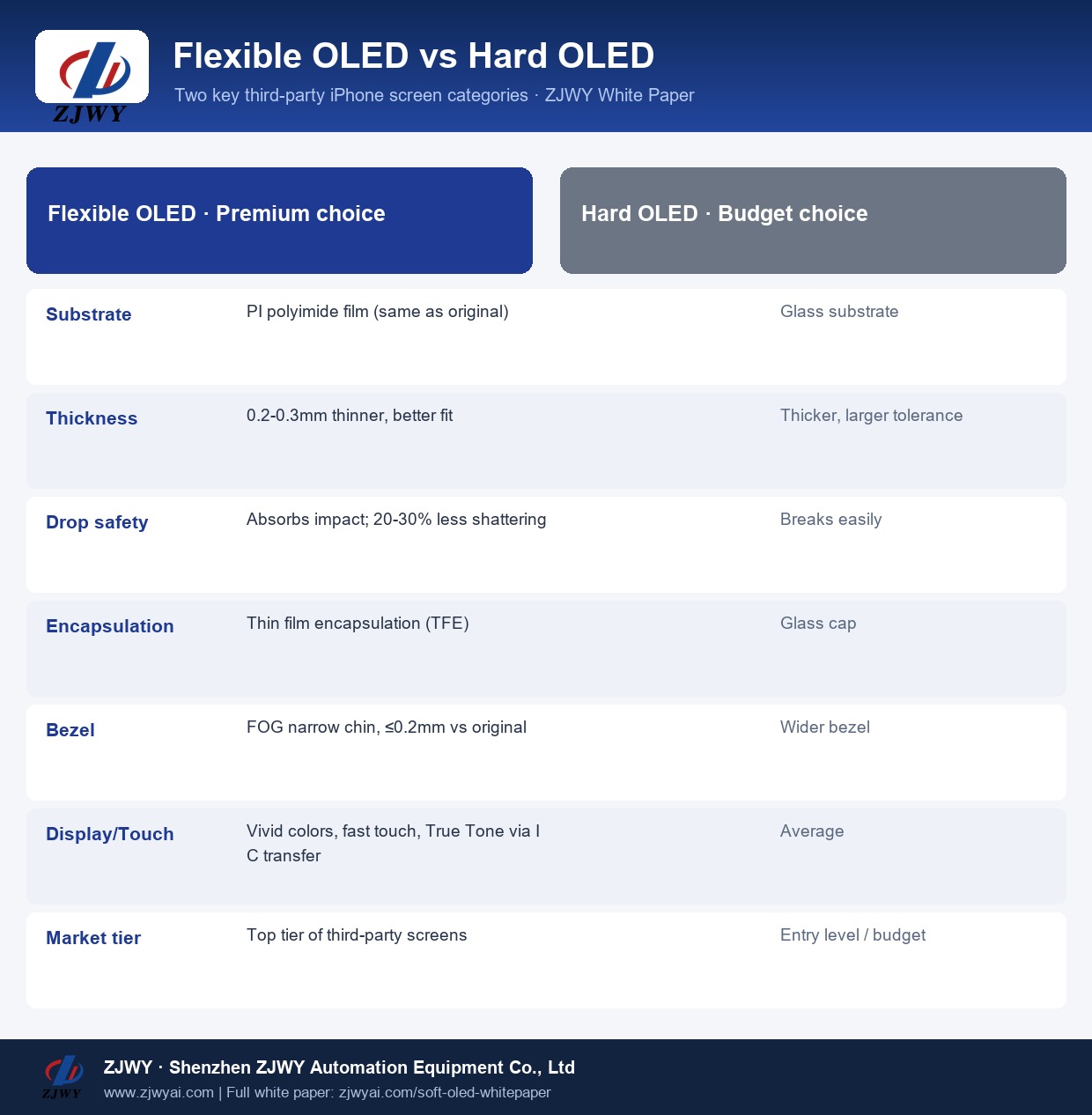
- Bend Test: Flexible OLED edges can bend slightly (≤30°), while hard OLED with glass substrate cannot bend at all
- Thickness Comparison: Flexible OLED module is 0.2-0.3mm thinner than hard OLED of the same model, with better flush fit after assembly
- Bezel Width: Flexible OLED has bottom bezel closer to original, while hard OLED generally has 0.5mm+ wider bottom bezel
5.2 Flexible OLED Quality Grade Identification
- Appearance & Process Check
- Flex cable: High-end products have fine-patterned cables bonded flat to the panel; low-end products have obvious unevenness and thick adhesive stickers
- Bezel: Premium products have uniform black bezels with size difference ≤0.2mm vs. original; inferior products have wider bottom bezel and misaligned notch/Dynamic Island cutouts
- Display Performance Check
- Low brightness test: Premium screens show no obvious vertical stripes or graininess at low brightness; low-end screens show prominent stripes and graininess
- Color uniformity: No local yellowing or dimming on pure white display, with small color deviation
- Functional Completeness Check
- High-end products fully support True Tone, auto-brightness and 120Hz adaptive refresh rate
- Low-end products often cut features like True Tone and ambient light sensing; high-refresh models only support fixed 60/120Hz switching
6 Selection & Application Guide
6.1 Selection by Quality Requirement
- Original-grade experience: Prioritize H* high-end COP flexible OLED or original refurbished screens, suitable for iPhone 14 Pro and newer models, meeting full requirements for high refresh rate, color accuracy and brightness
- Cost-effective mainstream repair: R* and D* COF version flexible screens balance display quality and procurement cost, ideal for iPhone 12-13 series mass repair scenarios
- Entry-level flexible demand: J* and other entry-level flexible screens deliver basic OLED experience with pure black and high contrast, suitable for budget repairs of older models
6.2 Selection by User Scenario
- Strobe-sensitive users: Prioritize R* DC-like dimming versions to reduce low-brightness flicker irritation
- Frequent outdoor use: Choose H* and D* COP versions with peak brightness ≥1000 nits for better outdoor visibility
- Mobile gaming users: Choose H* and D* high-refresh versions with LTPO adaptive refresh rate for both smoothness and power efficiency
6.3 Procurement Notes
- Prioritize versions supporting IC migration and system pop-up free to avoid iOS compatibility issues
- Verify cover glass hardness; prefer 9H hardness covers for better drop resistance
- For high-refresh models, confirm LTPO adaptive refresh rate support instead of fixed two-level refresh rate only
7 Installation & Usage Precautions
7.1 Installation Operation Standards
- Flexible PI substrate is fragile. Do not bend the panel over 30°, and never fold or squeeze the center of the panel
- Do not apply stress to the bent flex cable area at the bottom of the screen during assembly
- Apply uniform pressure during lamination; avoid excessive local pressure that causes PI substrate delamination or circuit damage
7.2 End User Tips
- Flexible OLED still has the inherent screen burn-in risk of OLED technology. Avoid displaying static images at high brightness for extended periods
- Replace damaged cover glass promptly to prevent sharp objects from damaging the internal flexible substrate and causing total screen failure
- Third-party assembled screens have weaker water resistance than original factory screens. Avoid liquid exposure after repair
Parameters in this document are compiled from public industry technical materials and general repair market standards. Refer to supplier specifications for exact product parameters.
Need flexible OLED screen pricing?
We manufacture and supply iPhone flexible OLED (Soft OLED) screens and screen repair equipment — original-cable and copy-cable full ranges, bonding machines, laser machines and consumables — with B2B wholesale and OEM/ODM support. Check live prices and specs, or contact us for volume quotes.
About ZJWY
Shenzhen ZJWY Automation Equipment Co., Ltd (ZJWY) is a manufacturer of industrial automation equipment for the display panel industry. We focus on screen repair equipment and solutions — bonding machines, COG/COF IC pre-bonding systems, ITO laser repair machines, laminating machines, inspection tools and flexible OLED display accessories — and provide OEM/ODM services. Every shipment is backed by full documentation, firmware updates, video tutorials and direct engineering support.
Contact Us
- Company
- Shenzhen ZJWY Automation Equipment Co., Ltd
- Address
- Room 501, 5F, Building C, Block 1, AI Digital Valley, Taoyuan Community, Dalang Street, Longhua New District, Shenzhen, Guangdong, China
- Contact
- Zhang Guohua +86 135 1061 9063
- 13510619063@163.com
- +86 158 8973 6761 / +86 137 1481 7731 / +86 136 2022 8197
- Website
- www.zjwyai.com